+1 646 759 2860


 go@wofdi.com






We do planning, you do cheering
2030 World Cup Travel Packages
The centenary World Cup, played in six countries on three continents. Pre-book now and we plan every step around your team.
10,000+ travellers since 2016
IATA & i.s.t.a.a accredited
2018, 2022 & 2026 World Cups
The 2030 World Cup runs from June 8 to July 21, 2030, in six countries on three continents. Centenary matches open it in Montevideo, Buenos Aires and Asunción, then Spain, Portugal and Morocco host the rest, up to the Final on Sunday, July 21. World of Discoveries is taking pre-bookings now.
- Tournament
- June 8 – July 21, 2030
6 countries, 3 continents - Opener & Final
- Centenary matches June 8–9
Final Sunday, July 21 - Packages
- Pre-booking open
Prices with the schedule - Included
- Lodging, transfers, tour leader, ticket concierge
Six countries, one plan built around your team
This World Cup can take you from a winter night in Montevideo to a summer evening in Seville, Lisbon or Casablanca. Tell us your team, how many days you have and the lodging standard you expect, and we join the cities, the matches and the days in between into one trip, with someone looking after you at every step.
- 1You pre-book and tell us your team, your dates and your lodging category.
- 2After the draw, we confirm your cities, and your ticket concierge guides you through the official process for every match in your package.
- 3Your tour leader meets you on arrival, briefs you on the city and looks after transfers, match days and the days between games.
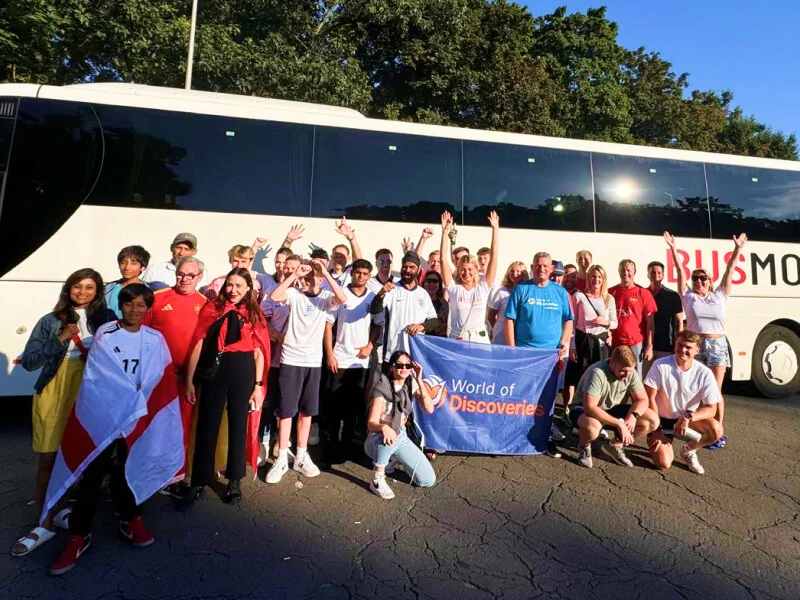
Packages are on the way. Pre-booking is open.
Packages and prices will be published once the match schedule is confirmed. Until then, we accept pre-booking requests for every host region: tell us your team and where you want to be, and you are first in line when packages open. Every 2030 package will include hand-picked 3–4★ lodging in central districts, private airport transfers, transfers to the stadium on match days, travel between host cities, guided city tours, welcome and farewell parties, a dedicated tour leader, our ticket concierge service and 24/7 support.
Why fans travel with World of Discoveries
Your safety comes first
We choose lodging in central, well-reviewed districts, every airport transfer is private, and match-day transport is arranged for you. In Morocco and South America, as everywhere, you always have someone to call, day or night.
We know World Cups
We took fans to the 2018, 2022 and 2026 World Cups, the 2020 and 2024 Euro Cups and numerous Champions League Finals. Big-tournament match days are our routine.
English and Spanish, 24/7
Your tour leader speaks English and Spanish, and our operations office answers by phone or WhatsApp at any hour, from landing to departure.
More than football
Days between matches are planned too, with guided city tours, excursions and a welcome party, whether you are in Madrid, Lisbon or Marrakesh.
Pre-book your 2030 World Cup trip
Tell us your team and how you like to travel. A travel planner replies with a first outline of your itinerary and confirms your place on the pre-booking list, with no obligation to book.
2030 World Cup schedule
44 days, the longest World Cup ever. The key dates are fixed; the full match-by-match schedule follows the final draw, and we update this page as soon as it is published.
Centenary matchesJune 8 – 93 matches
Opening & group stageFrom Thu, June 13Dates after the draw
Knockout roundsLate June – JulyDates TBC
FinalSun, July 211 match
2030 World Cup host cities & stadiums
Around 20 stadiums in Spain, Portugal and Morocco, plus three centenary venues in South America. Spain's list is still being finalised and the Final venue is due to be announced. Stadiums are listed under their everyday names.
Spain
1MadridSantiago BernabéuFinal contenderFinal contenderSun, July 21Dates TBC

Santiago Bernabéu
Capacity: about 80,000 · Madrid, Spain
Real Madrid's home on the Paseo de la Castellana, in the middle of the city, rebuilt with a retractable roof and pitch. It staged the 1982 World Cup Final and is one of three stadiums in contention for the 2030 Final.
2BarcelonaCamp NouFinal contenderFinal contenderSun, July 21Dates TBC

Camp Nou
Capacity: about 105,000 after redevelopment · Barcelona, Spain
FC Barcelona's home, redeveloped to become the largest stadium in Europe. A short metro ride from the city centre, the beaches and the Gothic Quarter.
3MadridMetropolitanoHost venueHost venueDates TBC

Metropolitano
Capacity: about 70,000 · Madrid, Spain
Atlético Madrid's home since 2017, in the east of the city and directly connected by metro. It hosted the 2019 Champions League Final.
4SevilleLa CartujaHost venueHost venueDates TBC

La Cartuja
Capacity: about 70,000 after expansion · Seville, Spain
Seville's largest stadium, on the Isla de la Cartuja beside the Guadalquivir river, being expanded for 2030. It hosted matches at the 2020 Euro Cup.
5BilbaoSan MamésHost venueHost venueDates TBC

San Mamés
Capacity: about 53,000 · Bilbao, Spain
Athletic Club's riverside home, opened in 2013 and a short walk from the old town and the Guggenheim Museum. Bilbao is one of the cooler host cities in July.
6Barcelona · Cornellà-El PratRCDE StadiumHost venueHost venueDates TBC

RCDE Stadium
Capacity: about 40,000 · Barcelona · Cornellà-El Prat, Spain
Espanyol's home since 2009, in the Barcelona metropolitan area and close to the airport.
7San SebastiánAnoetaHost venueHost venueDates TBC

Anoeta
Also known as Reale ArenaCapacity: about 40,000 · San Sebastián, Spain
Real Sociedad's home, renovated in 2019, in a seaside city known for La Concha beach and its pintxos bars.
8Las PalmasEstadio de Gran CanariaHost venueHost venueDates TBC

Estadio de Gran Canaria
Capacity: about 42,000 after expansion · Las Palmas, Spain
Home of UD Las Palmas and the only island venue of the tournament, in the Canary Islands off the coast of Africa, with warm, steady weather in summer.
9ZaragozaNueva RomaredaHost venueHost venueDates TBC

Nueva Romareda
Capacity: about 43,000 (new stadium) · Zaragoza, Spain
A new stadium for Real Zaragoza, built on the site of the old La Romareda, halfway between Madrid and Barcelona.
10ValenciaNou MestallaProposed venueProposed venueAwaiting confirmation

Nou Mestalla
Capacity: about 70,000 (new stadium) · Valencia, Spain
Valencia CF's new home, proposed by Spain as a replacement venue. If confirmed, it brings the tournament to Spain's third-largest city and its Mediterranean beaches.
11VigoBalaídosProposed venueProposed venueAwaiting confirmation

Balaídos
Also known as Abanca BalaídosCapacity: about 44,000 after renovation · Vigo, Spain
Celta Vigo's home on the Atlantic coast of Galicia, proposed as a replacement venue. If confirmed, it would be the only host city in north-west Spain.
Portugal
12LisbonEstádio da LuzHost venueHost venueDates TBC

Estádio da Luz
Capacity: about 65,000 · Lisbon, Portugal
Benfica's home and Portugal's largest stadium. It hosted the 2004 Euro Cup Final and two Champions League Finals.
13LisbonEstádio José AlvaladeHost venueHost venueDates TBC

Estádio José Alvalade
Capacity: about 50,000 · Lisbon, Portugal
Sporting CP's home in the north of Lisbon, close to the airport and the metro.
14PortoEstádio do DragãoHost venueHost venueDates TBC

Estádio do Dragão
Capacity: about 50,000 · Porto, Portugal
FC Porto's home, which opened the 2004 Euro Cup and hosted the 2021 Champions League Final. Porto's riverside old town and port-wine cellars are a short metro ride away.
Morocco
15Near CasablancaGrand Stade Hassan IIFinal contenderFinal contenderSun, July 21Dates TBC

Grand Stade Hassan II
Capacity: planned 115,000 · Near Casablanca, Morocco
A new stadium between Casablanca and Rabat, planned as the largest football stadium in the world. It is one of three stadiums in contention for the Final.
16RabatPrince Moulay Abdellah StadiumHost venueHost venueDates TBC

Prince Moulay Abdellah Stadium
Capacity: about 69,000 · Rabat, Morocco
Rebuilt in Morocco's capital and opened in 2025, close to the royal city, the Kasbah of the Udayas and the Atlantic seafront.
17TangierGrand Stade de TangerHost venueHost venueDates TBC

Grand Stade de Tanger
Also known as Ibn Batouta StadiumCapacity: about 75,500 · Tangier, Morocco
Expanded for the 2030 World Cup, in the port city at the meeting point of the Atlantic and the Mediterranean, an hour by ferry from southern Spain.
18FezFez StadiumHost venueHost venueDates TBC

Fez Stadium
Capacity: about 55,800 after renovation · Fez, Morocco
In Morocco's oldest imperial city, home to the Fez el-Bali medina, one of the largest car-free urban areas in the world.
19MarrakeshMarrakesh StadiumHost venueHost venueDates TBC

Marrakesh Stadium
Capacity: about 45,900 · Marrakesh, Morocco
With the Atlas Mountains on the horizon, a short drive from the Jemaa el-Fnaa square and the souks. Evenings are the best time to explore in summer.
20AgadirAdrar StadiumHost venueHost venueDates TBC

Adrar Stadium
Capacity: about 46,000 · Agadir, Morocco
On Morocco's southern Atlantic coast, in a beach resort city with a long seafront promenade.
Uruguay
21MontevideoEstadio CentenarioCentenary matchCentenary matchSat, June 81 match

Estadio Centenario
Capacity: about 60,000 · Montevideo, Uruguay
Built for the 1930 World Cup and named after the centenary of Uruguay's first constitution. It hosted the first World Cup Final and stages the centenary opener 100 years later.
Argentina
22Buenos AiresEstadio MonumentalCentenary matchCentenary matchJune 8 – 91 match

Estadio Monumental
Capacity: about 85,000 · Buenos Aires, Argentina
River Plate's home and the largest stadium in South America. It hosted the 1978 World Cup Final.
Paraguay
23AsunciónAsunción stadiumCentenary matchCentenary matchJune 8 – 91 match

Asunción stadium
Expected: Estadio Osvaldo Domínguez DibbCapacity: to be confirmed · Asunción, Paraguay
Paraguay's centenary match is expected at the home of Club Olimpia in Asunción. We confirm the stadium in your itinerary as soon as it is officially announced.

Your World of Discoveries travel planner
A trip across this World Cup is worth talking through before you book. Your travel planner goes over your team, the matches you want to see, your lodging standard and how you would like to spend the days between games in Madrid, Lisbon, Marrakesh or Buenos Aires. You finish the call with a clear plan and your place on the pre-booking list.
2030 World Cup travel: your questions answered
When and where is the 2030 World Cup?
The 2030 World Cup runs from June 8 to July 21, 2030, in six countries on three continents. Spain, Portugal and Morocco host almost every match. Uruguay, Argentina and Paraguay each host one centenary match on June 8–9, marking 100 years since the first World Cup in Montevideo in 1930. The Final is on Sunday, July 21, 2030.
Where will the 2030 World Cup Final be played?
The Final is on Sunday, July 21, 2030, and the venue has not been announced yet. The Santiago Bernabéu in Madrid, the Camp Nou in Barcelona and the new Grand Stade Hassan II near Casablanca are the three contenders. World of Discoveries builds its Final packages around the stadium as soon as it is confirmed.
Can I book a 2030 World Cup package now?
Yes, as a pre-booking. World of Discoveries releases packages and prices once the match schedule and host cities are confirmed. Pre-booking now puts you first in line for lodging allocations, and your travel planner starts shaping the trip around your team and the matches you want to see.
Are match tickets included in the packages?
Tickets for the 2030 World Cup are tightly controlled and sold through an official process, so we don't sell or guarantee tickets directly. Your ticket concierge arranges your entry to every match in your package and guides you through each step, so you don't have to deal with the process on your own.
Is it safe to travel to Morocco and South America for the 2030 World Cup?
Yes, with sensible planning. Morocco, Uruguay, Argentina and Paraguay welcome millions of visitors every year, and Morocco staged Africa's continental championship in 2025–26 in several of its 2030 stadiums. With World of Discoveries you are never on your own: we choose lodging in central, well-reviewed districts, every airport transfer is private, match-day transfers are arranged, and your tour leader briefs you on arrival about local customs, getting around and the best areas to enjoy in the evening. Our support line answers in English and Spanish, 24/7, by phone or WhatsApp.
When will I know which cities my team plays in?
Teams are placed into groups at the final tournament draw, and the match schedule assigns each group to its stadiums. Once your team is drawn, we confirm your cities and plan the travel between them. Pre-booking now secures your place before demand rises.
Can I combine the centenary match in South America with matches in Europe or Africa?
Yes. The centenary matches are on June 8–9 and the main tournament opens in Spain, Portugal and Morocco on June 13–14, which leaves time to cross the Atlantic between them. Uruguay, Argentina and Paraguay play their second group matches in Spain, Portugal or Morocco on June 21–22. Your travel planner arranges the connection by the most convenient route.
What is the weather like during the 2030 World Cup?
Spain and Portugal are in high summer: Madrid and Seville often pass 35°C (95°F), while Bilbao, San Sebastián, Lisbon and Porto are milder. Morocco's coast (Casablanca, Rabat, Tangier, Agadir) is usually 24–28°C (75–82°F), but Marrakesh and Fez can reach 38°C (100°F). South America is in winter: expect 8–15°C (46–59°F) in Montevideo and Buenos Aires in early June. Pack light layers, sun protection and a warm jacket if you go to the centenary matches.
Do I need a visa or travel authorisation?
Spain and Portugal are in the Schengen Area, and visitors from the US, Canada, the UK, Australia and many other countries are expected to need the EU's ETIAS travel authorisation by 2030. Morocco, Uruguay, Argentina and Paraguay each have their own entry rules, and many nationalities can visit for short stays without a visa. Your travel planner confirms what applies to your passport in every country on your itinerary.
What currency is used, and what plugs do I need?
Spain and Portugal use the euro, Morocco the dirham (MAD), Uruguay and Argentina their own pesos, and Paraguay the guaraní. Cards are widely accepted, but carry some cash for markets and medinas in Morocco. Spain, Portugal, Morocco, Uruguay and Paraguay mainly use European two-pin plugs (Type C/F) at 220–230V, and Argentina uses Type I, so US, Canadian, UK, Mexican and Australian devices need an adapter.
Can I travel solo?
Yes. Many of our travellers come on their own. You can book a single room, or we can match you with another solo traveller to share a room and lower the cost.
Your 2030 World Cup starts with one conversation
Tell us your team and the matches you can't miss. We plan the rest, from the airport to the final whistle, wherever the tournament takes you.